CleanTalk Review: $12 Anti-Spam, and the Catch
CleanTalk is the right buy for a commercial WordPress site that wants spam gone without showing anyone a CAPTCHA: $12.00 a year for one website, no cap on spam checks, and $107.40 a year less than the cheapest Akismet plan a commercial site is allowed to use. The question a CleanTalk review has to answer is not whether it stops spam — it does — but whether it will quietly eat a real customer enquiry. It can, CleanTalk publishes five reasons why, and on a default install you have 15 days to catch it before the evidence is deleted for good.
Jump to: is it legitimate · what it costs · the $107.40 figure · will it block a real enquiry · what the one-star reviews say · is it the wrong buy for you · the verdict · questions
Is CleanTalk legitimate, and what is it used for?
Yes, and the evidence is dull rather than dramatic. The WordPress plugin Spam protection, Honeypot, Anti-Spam by CleanTalk had 200,000+ active installations on 12 September 2026, a 4.8 out of 5 rating from 3,211 reviews, and version 6.87 published in September 2026. It supports WordPress 4.7 and above, is tested to WordPress 7.1, needs PHP 7.2, and carries 23 translated locales. CleanTalk’s own homepage claims more than 1,098,000 websites use the service.
What it is used for: blocking spam in the places a WordPress site accepts input — comments, user registrations, contact forms, search, subscriptions and WooCommerce checkout — by scoring each submission against a cloud database instead of asking the visitor to solve a puzzle. It is a paid service with a free GPL plugin as its client. Without an access key the plugin protects nothing.
WPNeon runs Anti-Spam by CleanTalk 6.87 on this site, and does not run Akismet.
Anti-Spam by CleanTalk on WordPress.org
How much does CleanTalk cost?
CleanTalk sells the anti-spam service by number of websites, billed yearly, with a single monthly option at the top of the ladder. Every plan carries the same promise on volume: “All packages include unlimited anti-spam protection, which means there are no limits on API calls.”
| Websites | Price | Per site per year | Spam checks | Best for |
|---|---|---|---|---|
| 1 | $12.00 / year | $12.00 | Unlimited | One commercial site |
| 3 | $24.00 / year | $8.00 | Unlimited | The steepest saving on the ladder |
| 5 | $36.00 / year | $7.20 | Unlimited | A small portfolio |
| 10 | $69.00 / year | $6.90 | Unlimited | Barely cheaper per site than five |
| 20 | $115.00 / year | $5.75 | Unlimited | Agency work |
| 30 | $160.00 / year | $5.33 | Unlimited | Agency work |
| 40 | $200.00 / year | $5.00 | Unlimited | The cheapest per-site rate published |
| Unlimited | $27.00 / month, or $324.00 a year | Wins on cost past about 65 sites | Unlimited | Large hosts and networks |
Prices in US dollars, read from CleanTalk’s anti-spam price page on 12 September 2026. The per-site column and the 65-site break-even are calculated from those prices.
Use the per-site column. The steepest saving is the first step: moving from one site to three cuts the cost per site by a third, from $12.00 to $8.00. If you run a second site, or expect to within a year, the three-site plan is the better buy even with a slot sitting empty. From five sites to ten the saving is trivial — $7.20 against $6.90 — so buy the count you actually have.
The unlimited plan is a different animal. It is monthly only, at $27.00, which is $324.00 a year, with no annual equivalent published. At the 40-site plan’s rate of $5.00 per site per year, $324.00 buys 64.8 sites’ worth of protection, so the unlimited plan only starts winning on cost once you are running about 65 sites. Below that it buys convenience, not savings. A pay-as-you-go option is referenced in CleanTalk’s range, but the price page carries no rate for it, so settle that before you plan around it. Neither the price page nor the homepage states a trial length or a money-back guarantee.
Affiliate link
The figure that decides it: $107.40 a year
CleanTalk’s one-site plan costs $12.00 a year. The cheapest Akismet plan a commercial site is allowed to use, Akismet Pro, is $9.95 a month billed yearly, which is $119.40 a year. The gap is $107.40 a year, and CleanTalk is 10.05% of Akismet Pro’s price.
The derivation is plain: $9.95 multiplied by twelve is $119.40; $119.40 minus $12.00 is $107.40; $12.00 divided by $119.40 is 0.1005. Both prices were read from the vendors’ own pricing pages on 12 September 2026.
The comparison sharpens when you look at what the money buys. Akismet Pro’s $119.40 includes 500 spam checks a month for one site. Spread across an average month that is 16.4 checks a day — 500 divided by 30.44 — which one determined bot can exhaust before lunch. CleanTalk’s $12.00 plan has no check ceiling at all. The pattern holds at the top of both ladders: Akismet Business is $49.95 a month billed yearly, or $599.40, for unlimited sites and 5,000 monthly checks, against CleanTalk’s $324.00 a year for unlimited sites and unlimited checks.
Akismet keeps one advantage CleanTalk cannot match: a name-your-price Personal plan for non-commercial sites, which means a hobby blog can be protected for nothing. If your site takes money, that door is closed and $107.40 is the real number.
Will CleanTalk block a real customer enquiry?
Sometimes, yes. This is the objection worth taking seriously, because a missed enquiry costs more than a hundred spam comments, and it fails silently — nothing tells you the message you never received was ever sent.
Two things are true at once. CleanTalk publishes a root-cause page on false positives, which is more candour than most anti-spam vendors offer. And no false-positive rate appears anywhere on CleanTalk’s price page, homepage or help pages, so nobody — including CleanTalk — can tell you the odds. Treat any review that quotes an accuracy percentage as unsourced.
CleanTalk names five causes. The one it calls the most frequent is technical rather than judgemental: “The most frequent cause of false positives is incorrect collection of form parameters upon submission” — that is, the plugin failing to read a form builder’s fields properly, so a real person’s submission arrives at the API looking like nothing. The other four are a mistyped email domain such as gmail.con, the site owner’s own block lists, manual advertising spam, and VPN addresses, which CleanTalk says “are frequently used by spammers and bots, and consequently, may end up on blocklists”.
How to find out whether CleanTalk has blocked something it should not have
- Open the WordPress Spam folder first, and note the deadline. Blocked comments are moved there by default, and CleanTalk’s own setting text is explicit about how long they last: “Keeps all spam comments in the ‘Spam’ folder for 15 days. Spam comments older than 15 days will be automatically permanently deleted.” Fifteen days is your entire window to notice.
- Check whether the silent option is switched on. The plugin readme states that spam comments “are being moved to SPAM folder by default or you can set the option to ban spam comments silently”. If a previous administrator enabled that, there is nothing in the folder to find and step one tells you nothing. Confirm it before you conclude you have no false positives.
- Use the Anti-Spam Log for everything that is not a comment. Contact-form and registration blocks do not land in the Spam folder. They are recorded in the log in the CleanTalk dashboard, which stores blocked and allowed requests alike with the blocking reason, the sender’s nickname, email and IP, the country, the page URL, the message text, the user agent, the referrer and the timestamp. Search by IP, email or nickname — email masks with asterisks work, and the expression needs at least one @ and one dot — or filter by period, website, country, form type or page URL.
- Reverse it from the log. CleanTalk’s documentation is direct: “If the request was mistakenly blocked, you can mark it as Not Spam, in this case, the IP and Email address of the sender will be added to your personal whitelist.” That both releases the sender and stops the same person being blocked again.
- Run the existing-content check before you trust a clean result. The “Check the comments/users for spam” tool scans the accounts and comments already on the site against the database. CleanTalk advises a full backup first, offers “Accurate check” and “Specify date range” options, and warns that “not all found records can be spam as the IP addresses of users/spammers change over time”. Deleting in bulk from that screen is not documented as reversible, so read the list before you clear it.
The settings that stop it happening again
Four exclusions do most of the work, and they are worth setting on day one rather than after you lose an enquiry. “Roles that bypass the spam test” exempts user roles you trust. “URL exclusions” exempts whole pages, such as an internal tool or a staff form. “Field Name Exclusions” exempts named form fields, with one documented limit worth knowing: CleanTalk states “It’s technically impossible to exclude ‘Email’ and ‘Nickname’ fields on some forms.” “Form Signs Exclusions” matches on the keys a form posts, for builders whose field names change.
Beyond exclusions, “Don’t check trusted users’ comments” stops checking a commenter after three approved comments, and the personal lists let you act on an individual. In the dashboard each entry gets two buttons: “You can allow or block the address you have entered by pressing the buttons ‘Whitelist’ or ‘Blacklist’.” Those lists take IP addresses, email addresses, masked emails such as *@mail.com, domains, stop-words and languages. Countries can only be blocked, never allowed — CleanTalk’s stated reason is that whitelisting a country “will result in many false negatives”.
What site owners actually report
The WordPress.org support forum is the honest record here, and it is smaller than the noise suggests. The threads that do exist follow a pattern. In December 2023 a user reported 36 of 1,381 comments flagged, “mostly gmail adresses”, and was directed to the Anti-Spam Log to see whether the senders’ IPs or emails had been blocklisted. In June 2025 a site owner reported registrations being blocked wholesale; CleanTalk’s support traced it to page caching serving stale form tokens and advised a cache refresh interval of no more than 24 hours. Neither thread ends with a confirmed fix on the record, which is its own useful signal about how these cases close.
The most-discussed complaint on the wider web is a Reddit thread about a rise in false positives, which sits high on the results page for this product. It is worth knowing it exists and worth treating as anecdote: it is a single unverified report with no log evidence attached, and it is not corroborated by the volume of forum threads or the one-star reviews below.
What has no good answer is the blocked visitor’s side. There is no published appeals route a rejected person can use themselves, and no service-level commitment on how fast a wrongly blocked sender is released. Every path runs through the site owner or a support ticket. If your business depends on cold inbound enquiries from strangers, build the Spam-folder check into someone’s weekly routine rather than trusting the filter.
CleanTalk’s own page on false positives
What the one-star reviews actually say
CleanTalk’s WordPress.org listing carries 3,211 ratings at 4.8 out of 5. The breakdown on 12 September 2026 was 2,966 five-star, 40 four-star, 20 three-star, 26 two-star and 159 one-star — a 4.95% one-star share. The reviews-per-install ratio is unusually high for a background utility at 16.06 reviews per 1,000 active installs, which is why the pile is worth reading rather than skimming.
Reading the 30 one-star reviews on the first page of the filtered list gives a result that cuts against the search results:
- 11 of 30 are about the paywall, the trial or the renewal. This is the dominant theme by a wide margin. Titles run from “Only free trial” and “Just a trial” to “Useless until you want to pay for it” and, in August 2026, “Unscrupulous Upgrade Tactics”. The underlying grievance is consistent: people install a plugin listed as free, find it protects nothing without a paid key, and rate it one star for that alone.
- 7 of 30 are about admin nagging. Review-request banners and upgrade notices inside wp-admin, in titles such as “Non-stop WordPress admin spam” and “Still seeing your review request banner”. An irritation rather than a failure, but a persistent one.
- 5 of 30 say the protection did not work — spam getting through, or returning when a trial lapsed.
- 5 of 30 report breakage or technical trouble, including “They broke my website” and one complaint that the honeypot field was visible to visitors.
- 1 of 30 is about a false positive — “DO NOT USE – SPAMS LEGITIMATE EMAILS”, from March 2023.
- 1 of 30 is about support, titled “Can’t get help”.
That single count is the most useful thing in this page. The fear the search results amplify is false positives; the complaint people actually file is that the plugin is not free and keeps asking them for money. Both are real, but they are not the same risk, and they point at different buyers. If the $12.00 is fine with you and you can live with an admin notice, the one-star pile is mostly not about you.
Rating breakdown and review titles read from the WordPress.org listing for cleantalk-spam-protect on 12 September 2026. The thematic counts cover the 30 one-star reviews shown on the first page of the filtered list, not all 159.
Is CleanTalk the wrong buy for you?
CleanTalk is the wrong buy if…
- You need something that is genuinely free. The plugin is free and GPL-licensed, but it is a client for a paid service and protects nothing without a key. That is what 11 of the 30 one-star reviews are complaining about. There is no free tier to fall back on at $0.
Better pickAkismet’s name-your-price Personal plan if the site is non-commercial, or Antispam Bee, which is free on any site. Both sit in our anti-spam plugin roundup. - You cannot send visitor form data to a third-party cloud. Every checked submission leaves your server to be scored. Under GDPR that is a processor relationship you have to document, and for some legal, health and public-sector sites it is simply not allowed.
Better pickA local filter that never calls out — Antispam Bee, or the honeypot built into your form plugin. You lose the shared blocklist, which is most of the accuracy. - A single missed enquiry would cost you more than a year of spam. No false-positive rate is published, blocked comments are deleted after 15 days, and there is no appeals route for the person who was blocked. If nobody will be checking the Spam folder, an automated filter with no human in the loop is the wrong shape of tool.
Better pickKeep CleanTalk but turn off silent banning, put the Spam-folder check in a weekly routine, and set role and URL exclusions for the forms that matter. If you would rather compare the field first, read the Akismet-alternatives comparison.
Buy CleanTalk if…
- Your site is commercial and Akismet Pro’s price annoys you. $12.00 against $119.40 a year for the same job, with no check ceiling against Akismet’s 500 a month.
- You want the CAPTCHA gone. CleanTalk’s whole design is “no CAPTCHA, no puzzles, no visitor friction”, and every puzzle you remove is conversions you keep.
- You get hit by volume, not by cleverness. SpamFireWall turns away known spam addresses before they load a page, which cuts server load during a flood instead of cleaning up after it.
- You run several sites. Three sites for $24.00 is $8.00 each, the steepest saving on the ladder.
What CleanTalk actually blocks
Three mechanisms do the work and they stack. A honeypot field is added to your forms: invisible to people, irresistible to bots. The cloud check sends each submission to CleanTalk’s servers to be scored against a database the homepage describes as “5+ million spam-active IPs”. SpamFireWall sits in front of both and turns away the most active spam addresses before they load a page at all.
None of it shows a puzzle to a visitor. CleanTalk’s framing is “No CAPTCHAs, no puzzles, and no visitor friction — just automatic spam blocking for forms, comments, registrations, subscriptions, and fake orders”.
In the settings you switch protection on per form type — registration, comments, contact, search, external and custom forms. The listing names Contact Form 7, WPForms, Ninja Forms, Elementor, Gravity Forms, Formidable Forms, JetFormBuilder, Everest Forms and Fluent Forms explicitly, alongside WooCommerce and bbPress, then claims compatibility with many more builders.

Setting it up, and the language question
Register on CleanTalk’s website with an email address and your site URL to receive an access key. Install the plugin from the WordPress directory, activate it, and paste the key. The settings screen then switches to “Protection is active” with a green check against each form type. No code, a few minutes.
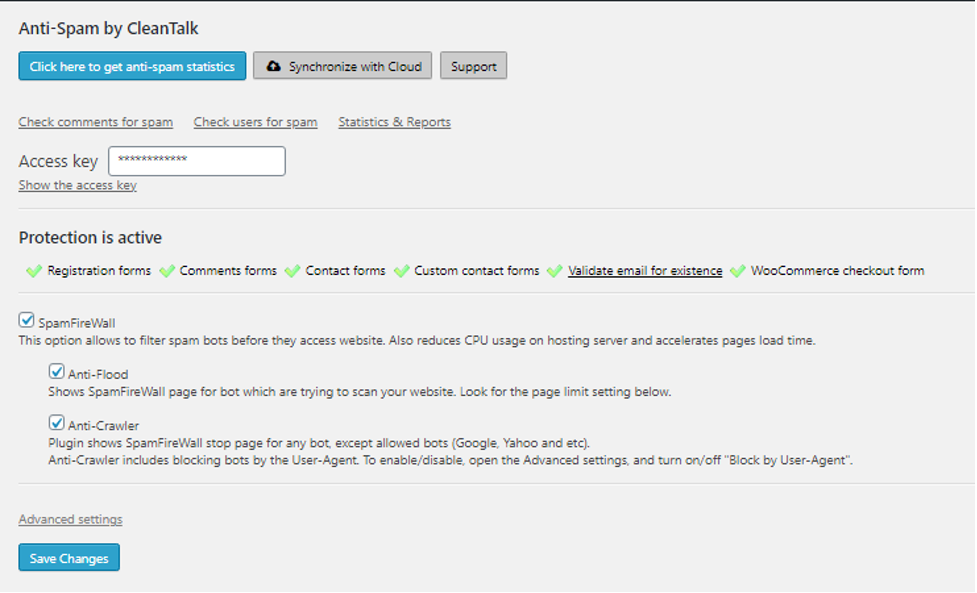
Change four things from the defaults before you walk away, all of them insurance against the false-positive problem above. Set the role and URL exclusions for any form your own staff or members use. Confirm spam comments are going to the Spam folder rather than being banned silently. Turn on “Log excluded requests” so the things you exempted are still recorded. Then run the existing-comments-and-users check to sweep up spam that arrived before you installed anything.
On language: the WordPress.org listing names 23 locales, which is respectable rather than comprehensive. The list runs from Albanian and Catalan through German, Japanese, Kurdish (Sorani), Polish and Russian to three variants of Spanish. Slovak is not among them, so if you want a Slovak admin interface, expect English instead. The service itself covers WordPress, Joomla and Drupal alongside its API and blocklists.
Verdict
For a commercial WordPress site with a spam problem, buy it. $12.00 a year for one site, no check ceiling, no puzzle in front of your visitors, and $107.40 a year less than Akismet Pro. It is one of the cheapest fixes on the market that actually works, and the one-star pile is mostly about the paywall rather than the filtering.
If you need free, or you cannot send form data to a cloud, look elsewhere. There is no free tier, and no amount of configuration changes that.
Whichever you buy, do not leave the filter unwatched. No false-positive rate is published, silent banning is an option someone may have enabled, and blocked comments are gone after 15 days. Two things to settle at signup, because CleanTalk publishes neither: how long the trial runs, and whether a refund exists.
Affiliate link
Once you have chosen
Three things usually come next.
- The WordPress anti-spam plugin roundup — if you want to see CleanTalk priced against the free options before you commit $12.00.
- The Akismet-alternatives comparison — if you are leaving Akismet and want the switch mapped out rather than guessed.
- Contact form plugins — because the form builder you choose decides how cleanly CleanTalk can read your fields, which is the cause it names first for false positives.
Frequently asked questions
Is CleanTalk.org legitimate?
Yes. The WordPress plugin had 200,000+ active installations on 12 September 2026, a 4.8 out of 5 rating from 3,211 reviews, and version 6.87 published in September 2026. CleanTalk’s homepage claims more than 1,098,000 websites use the service. It is a paid product with a free plugin as its client, not a free plugin that later demands money by surprise.
How much does CleanTalk cost?
On 12 September 2026 CleanTalk listed one website at $12.00 a year, three at $24.00, five at $36.00, ten at $69.00, twenty at $115.00, thirty at $160.00, forty at $200.00, and an unlimited plan at $27.00 a month. Every plan includes unlimited spam checks with no limit on API calls.
What is CleanTalk.org used for?
Blocking spam wherever a website accepts input: comments, user registrations, contact forms, subscriptions, search and WooCommerce checkout. It scores each submission against a cloud database of spam-active addresses instead of showing the visitor a CAPTCHA. CleanTalk also sells blocklist and IP-lookup access, and supports Joomla and Drupal alongside WordPress.
Does CleanTalk block legitimate users?
Sometimes. CleanTalk publishes five causes, naming incorrect collection of form parameters as the most frequent, but publishes no false-positive rate. Blocked comments sit in the WordPress Spam folder for 15 days before permanent deletion, and other blocked submissions appear in the Anti-Spam Log, where marking a request Not Spam adds the sender’s IP and email to your personal whitelist.
Is CleanTalk free?
The plugin is free and GPL-licensed, but it only works with CleanTalk’s paid cloud service, and without an access key it provides no protection. This is the single most common complaint in the one-star reviews. A free trial is referenced, but no trial length was stated on the price page or homepage on 12 September 2026.
Is CleanTalk cheaper than Akismet?
For a commercial site, by a wide margin. Akismet Pro is $9.95 a month billed yearly, or $119.40 a year, for one site and 500 spam checks a month. CleanTalk is $12.00 a year for one site with no check limit, a saving of $107.40 a year. Akismet is cheaper only for non-commercial sites, through its name-your-price Personal plan.
