Duplicate a WordPress Page: Methods and SEO Checks
Need a second WordPress page with the same layout—but don’t want to accidentally replace the original? There are three practical approaches: copy blocks into a fresh draft, clone the page with a plugin, or reuse a page-builder template. Choose based on whether you need only the content or also the page’s settings and layout metadata.
What to change in the duplicate before publishing
Keep the copy as a draft while you make it a genuinely separate page. Review the title, slug, featured image, SEO description and canonical setting. A duplication plugin may copy more metadata than the block editor does.
- Replace old offer details and internal links.
- Check form recipients and hidden campaign fields.
- Review shared or synced patterns before editing their text.
- Confirm template and builder dependencies.
- Preview the new URL while logged out after publishing.
Do not publish a near-identical indexable page just to target a small keyword variation. If you only need a reusable design, save a suitable pattern or template. For a whole-site copy, use our separate WordPress cloning guide.
Pick the quickest safe method
One ordinary block-editor page: use Copy all content. Many posts or pages, including settings: consider Duplicate Page. Elementor, Divi or a custom builder: use the builder’s template or cloning workflow and verify which layout settings it preserves.
Method 1: copy all blocks without adding a plugin
- From Pages → All Pages, open the source page in the block editor.
- Open the editor’s top-right three-dot menu and look under Tools → Copy all content. WordPress’s block editor documentation describes this tool; its position may vary slightly by version.
- Go to Pages → Add New, enter a distinct title and paste the copied content into the editor (Ctrl+V on Windows; Command+V on Mac).
- Save the result as a draft, preview it and check images, internal links and any embedded blocks before publishing.

Limit: copying blocks does not necessarily carry across the page template, featured image, SEO metadata, custom fields or proprietary page-builder settings. For one reusable section, copy or duplicate its individual blocks instead of copying the entire page.
Method 2: clone the page with Duplicate Page
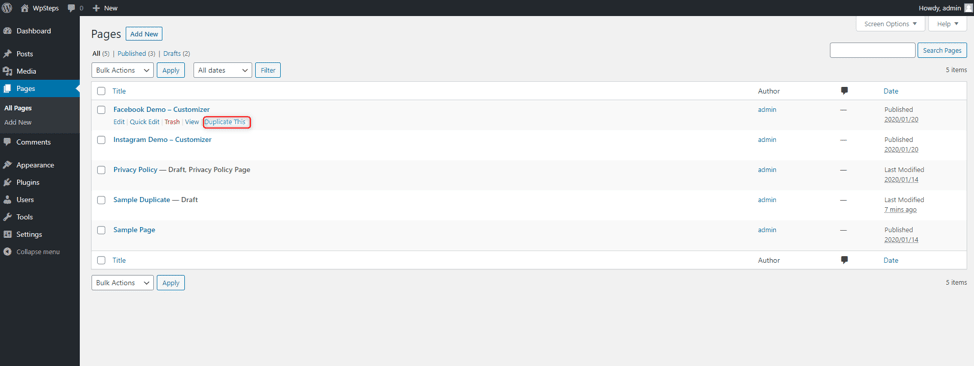
The free Duplicate Page plugin adds a cloning action for posts and pages. Its May 2026 changelog mentions fixes for Elementor/page-builder layout preservation and duplicate metadata handling—useful reasons to check the installed version rather than relying on an old tutorial.
- Back up the site, especially before cloning complex builder pages or products.
- Install and activate the plugin from Plugins → Add New, then inspect its duplication settings.
- Open Pages → All Pages and use the duplication action for the chosen page.
- Open the new copy, verify that it is a draft, change its title and intended URL, and inspect the template and metadata.
View installation and changelog →
Method 3: use an existing page-builder template
If the site uses Elementor, Divi or another builder, check for a built-in save-as-template or duplicate-page feature. Reusing a saved design is often better when several pages need the same structure but different content. Test the copy on staging, because each builder stores some settings differently.
Important: don’t publish two competing copies
A draft duplicate is handy for experimentation. Two publicly accessible pages with essentially identical content can confuse readers and create unnecessary search-indexing choices. Before publishing, decide whether the new page serves a distinct purpose, should replace the original, or should remain unpublished. If it replaces an old URL, plan the relevant redirect; if the two pages must remain live, give each unique, useful content rather than assuming a canonical tag fixes a weak duplicate.
Quick troubleshooting
Formatting disappeared? Copy all content from the block editor rather than selected text, or use the builder’s own export/template tool. Image missing? Check that it is in the media library and the new page references the right attachment. Cloned page is already public? Switch it to draft while editing. Navigation shows both versions? Review your menu or navigation block before launching.
For another everyday page setup task, see how to create a WordPress contact page.
